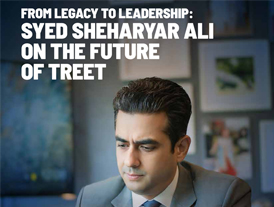
Syed Sheharyar Ali
On the Future of Treet
Treet Group is pursuing a diversified future across grooming, energy storage, batteries and healthcare. Its leadership emphasizes manufacturing excellence, international brands, predictable policies, sustainability, AI-driven efficiency and professional governance, while urging young entrepreneurs to build globally competitive businesses from Pakistan and focus on long-term, knowledge-based industries.
1. Treet has evolved from a blade manufacturer into a diversified group. What’s your vision for the next decade?
I want Treet to be a company that makes things people use every day and does it well enough that the country of origin stops being a disadvantage. That’s the whole ambition, and it’s harder than it sounds.
Practically, we’re built on three legs now. Grooming and personal care, which is where we came from and where we’ve moved from selling blades to building brands. Batteries and energy storage, which is where the demand curve in this country is steepest. And healthcare through Renacon, where we’re in dialysis, an area most people don’t want to be in because it’s difficult.
Ten years out, I’d like each of those to be able to stand on its own without the others carrying it. A conglomerate where one business subsidises three others isn’t a conglomerate, it’s a bailout with a letterhead.
2. Seventy years of legacy versus the need to disrupt. How do you balance it?
Honestly, legacy is mostly useful as a warning. It tells you what worked in a market that no longer exists.
What we’ve kept is the manufacturing discipline. Treet people know how to run a plant, control a cost line, and hold quality on a product that sells for very little money. That’s a real inheritance and you can’t buy it.
What we’ve had to let go of is the idea that we’re a blade company. We spent years being very good at making a commodity while the margin in that commodity went to zero. Genesis and Estela exist because at some point you have to accept that the thing you’re famous for is not the thing that will pay for your future.
3. High energy costs, taxation, currency volatility, import competition. What has to change?
Everyone in industry gives you the same list, so let me be more useful and rank it.
Energy first. Not the tariff alone, the unpredictability of it. I can plan around an expensive rupee. I cannot plan around not knowing what a unit costs eighteen months from now. Capital investment dies in that uncertainty, and capital investment is the only thing that makes manufacturing competitive over time.
Taxation second, and specifically the fact that the documented sector pays for the undocumented one. Every honest manufacturer in this country is carrying a passenger.
Currency third. It hurts, but exporters have some natural hedge in it.
The import competition question I’d answer differently. I don’t want protection. I want a level starting line. Under-invoiced imports aren’t competition, they’re just smuggling with paperwork.
4. Taking more Pakistani brands international. Where’s the opportunity?
The opportunity is real but I’d caution against the version of this conversation where we all agree Pakistani brands should go global and then nothing happens.
Going international as a brand is a completely different business from exporting as a manufacturer. Exporting means finding a buyer. Branding means spending money in a market for two or three years before it returns anything, in a currency you don’t earn, against competitors with a hundred years of shelf presence.
Where I think it works for us is in markets where we’re already known and where the consumer profile isn’t far from ours. We’ve had Treet on shelves in parts of Africa and the Middle East for decades. That’s an asset most Pakistani companies don’t have. The mistake would be starting with the hardest markets because they’re the most flattering to talk about.
5. Exports to 45-plus countries. Strategy for Europe, Africa, the Middle East, Central Asia?
We’re deliberately not treating those four as one plan.
Africa and the Middle East are where we grow through the same route we’ve always used, which is distribution partners who know their trade, plus more product per partner than we’re giving them today. That’s the fastest return available to us.
Central Asia interests me because of logistics. If the corridors through Afghanistan and into the CIS ever work properly, we’re closer to those consumers than most of our competition is. I’d call that a watch-and-position market rather than a today market.
Europe is the long game. Europe means certifications, retailer audits, sustainability documentation, and a level of consistency that forces you to improve your own factory. Even if the volumes take years, the discipline you have to build to get there is worth it on its own.
6. Batteries and energy storage. What’s Treet’s role in the transition?
We’re already in it, and not theoretically. Daewoo Battery is one of the more recognised names in the market, and we’ve moved on the cell sourcing side to bring in quality that customers can actually verify.
That last part matters more than people think. This is a market flooded with counterfeit product. A customer buying a battery has no way of knowing what’s inside it until it fails on a motorway at two in the morning. If we can build a position where our name on the box is a guarantee of what’s in the box, that’s worth more than any technology story.
On the transition itself, I’d separate electric vehicles from energy storage. Storage demand in Pakistan is here now, driven by solar going up on every second roof. EVs will come, but the honest answer is the timeline depends on charging infrastructure and financing, neither of which we control.
7. The automotive industry and EVs. How is Treet preparing?
By not betting the company on a date.
The mistake I see is people assuming the EV curve in Pakistan will look like the EV curve somewhere else. It won’t. Our two- and three-wheeler market is where the real electrification will happen first, because that’s what people actually ride and the economics work at that size.
So we’re building capability that’s useful either way. Cell relationships, chemistry knowledge, quality systems, and a brand people trust. If EV adoption is fast, we’re in position. If it takes another decade, that same capability is still earning money in conventional batteries and in storage. I’d rather be early on the capability and patient on the timing than the reverse.
8. Automation, AI, robotics, data analytics. Where’s the biggest opportunity in operations?
Procurement and cost visibility, and it’s not close.
Robots on a line are the version of this that photographs well. But in a business like ours, the money sits in knowing what you’re paying for every input, across three business units, and whether that’s the right price this week. Most manufacturing companies in this country cannot answer that question quickly. We’re getting better at it and every point of improvement drops straight to the bottom line.
After that, quality inspection. Machine vision on a blade line or a battery line catches things a tired human at the end of a shift will miss.
I’d be careful about the word transformation here. We’re doing a series of unglamorous improvements. That’s what it actually looks like.
9. How important will AI be to Treet’s future?
Useful, and being oversold at the same time. Both of those are true.
Where I already see it working is in the boring middle of the company. Forecasting demand so we don’t stock out on a product that’s selling. Reading through supplier contracts. Sorting through customer complaints to find the pattern instead of the loudest voice. Helping a small marketing team produce work a big team used to produce.
Where I’m sceptical is anyone claiming AI will make the strategic decisions. It won’t. It’ll get you to the decision faster with better information in front of you, and then you still have to be the one who says yes or no and lives with it.
10. Long-term vision for healthcare investments?
Renacon is in renal care, and specifically dialysis. It’s an unglamorous business with a brutal reality behind it, which is that kidney disease in Pakistan is far more common than people realise and treatment is expensive enough to bankrupt a family.
Our position is in the consumables and solutions side, and the long-term vision is to go further up the value chain rather than wider across therapeutic areas. I’d rather be genuinely important in one area of medicine than present in ten.
There’s also an export story there that we haven’t finished writing. Dialysis products are regulated, which is a barrier, and barriers are good news once you’re past them.
11. Young population, low productivity. What can large companies do?
Employ people properly and train them, which sounds obvious and is rarer than it should be.
The productivity problem isn’t a work-ethic problem. I’ve never met a Pakistani worker who didn’t want to do well. It’s that we put people on old equipment with no training and no path, and then wonder why output per head is low.
What a company our size can genuinely do is offer structured technical training, real apprenticeships, and a visible route from the shop floor to a supervisory role. What we cannot do is fix the schooling that arrives at our gate. That’s a state responsibility and no amount of corporate goodwill substitutes for it.
I’ll say one more thing. If you want productivity, hire women. Half the available talent in this country is barely being used and companies that figure this out will simply have a bigger pool to choose from than their competitors.
12. Professionalising and institutionalising a family business?
The hardest part is not hiring professionals. It’s letting them actually decide things.
Most family businesses in Pakistan bring in good people and then keep the real decisions in the family. Everyone can see it, so the good people leave within eighteen months and the family concludes that professional managers don’t work here.
What we’ve tried to do is put real P&L ownership into the businesses. Each unit owns its own numbers, including procurement, and the results are their results. That changes behaviour more than any consultant’s org chart.
The other thing I’ve learned is that the family has to accept being held to the same standard. If the rule applies to the head of a division but not to a family member, you don’t have a governance system, you have a story about one.
13. You became CEO young. The leadership lesson with the greatest impact?
That being right isn’t the job.
When I was younger I thought if I did the analysis properly and reached the correct answer, the organisation would follow. It doesn’t. People follow when they understand why, when they trust you’ll back them if it goes wrong, and when they’ve seen you change your mind in front of them at least once.
The second lesson took longer. Bad news has to travel to me faster than good news, and that only happens if the person carrying it doesn’t get punished for it. If your team is managing your mood, you’re getting a filtered picture of your own company.